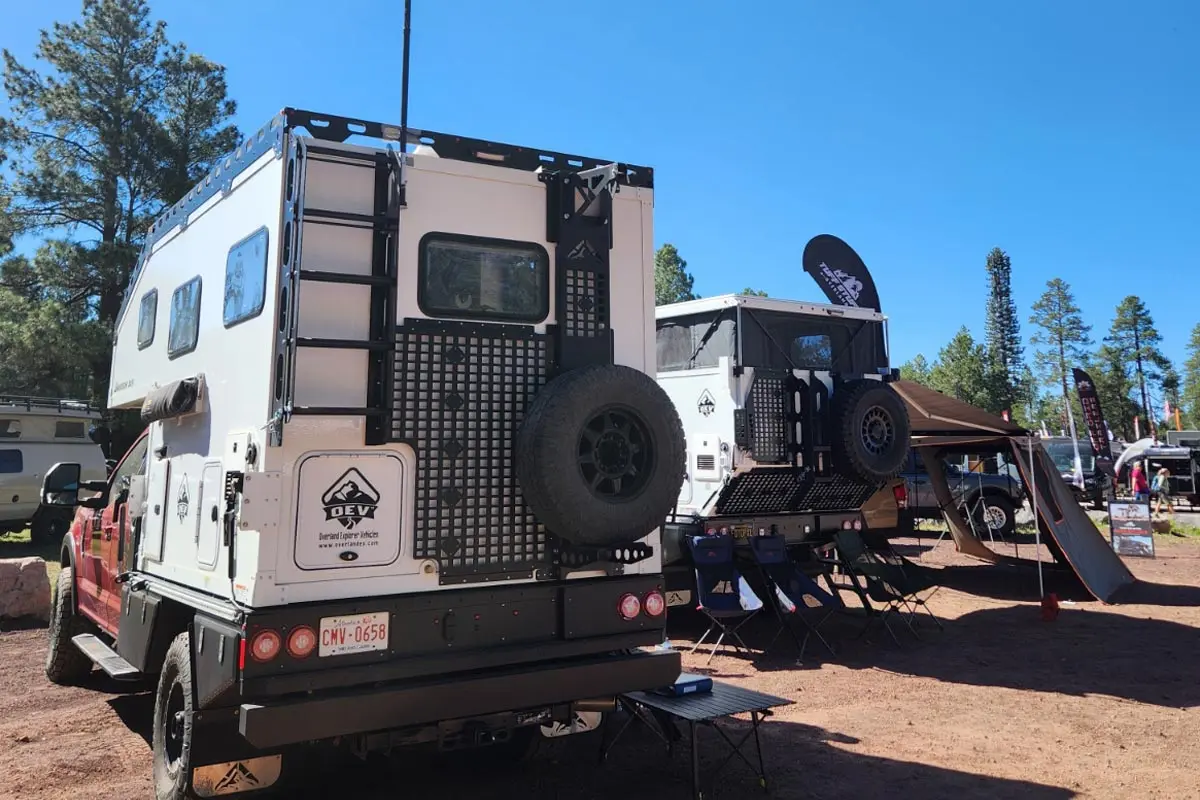
The 2024 Overland Expo season brought an incredible turnout to the OEV booth. Visitors ranged from experienced overlanders to people shopping their first truck camper, and the questions they asked were good ones. Here are the six we heard most, answered in full.
1. What's the Difference Between Slide-In, Flatbed, and Chassis-Mounted Campers?
These are three fundamentally different approaches to building an expedition vehicle, each with real trade-offs.
Slide-in truck campers slide into the truck bed and secure using custom brackets attached to the truck's frame, specifically to existing bed bolts, so there's no stress on the sheet metal. The big advantage is that the camper is easily removable: use your truck as a truck when you need to. The limitation is that the camper is constrained by truck bed dimensions. Best for people who want flexibility without permanent modifications.
Flatbed campers require removing the original truck bed and mounting an Aluma Tray flatbed to the chassis. The flatbed uses polyurethane isolators to reduce metal fatigue. Because you're working with a larger platform, you get significantly more living space: side entrance, larger dinette, indoor shower, expanded kitchen. The camper itself is still removable, but the modification to the truck is more permanent. Best for individuals and families who prioritize living space.
Chassis-mounted campers are permanently mounted using custom brackets and an isolated subframe. You get superior stability and spaciousness, additional fuel source options, and pass-through capabilities. The trade-off is that the truck becomes a dedicated camping vehicle. Best for full-time overlanding enthusiasts.
2. What Truck Do I Need?
This depends on the camper type.
- Slide-in models are compatible with most pickup trucks from mid-size to heavy-duty
- Flatbed campers are designed for full-size heavy-duty trucks
- Chassis-mounted units typically require heavy-duty cab chassis models: F450, F550, Ram 4500, or 5500
Finding the right truck-camper pairing before you commit is important. Our team can walk through this with you. Contact us before you buy.
3. Can My Truck Handle the Weight?
This is the right question to ask. Three numbers matter:
Payload capacity is the maximum safe carrying weight including passengers, cargo, and the camper itself. You'll find it on a sticker on the driver's side door jamb.
GVWR (Gross Vehicle Weight Rating) is the total weight limit of the truck plus everything in it.
GAWR (Gross Axle Weight Rating) is the weight limit for each individual axle.
To find your specific numbers: check the owner's manual, look at the door jamb or under-hood labels, or call your truck manufacturer directly.
If you're right at the limit, options include suspension upgrades, airbag installation for leveling and stability, and brake system enhancements. Also account for water weight, gear, and everything that accumulates over a trip. It adds up faster than people expect.
4. What Comes With the Camper?
Standard inclusions across models include a mattress, battery management system, freshwater tank, kitchen, and dining area. The specifics vary significantly by model. We're happy to walk through a full component list. Reach out or talk to your nearest dealer.
5. Can You Camp in Cold Weather?
Yes. OEV campers use composite hard walls with an R8 insulation value and pop-up material with R4 insulation. Both hard-side and pop-up models have been used successfully in winter conditions.
One important caveat: the water system is not designed for freezing temperatures and requires winterization before you push into cold weather. Freeze damage is not warranty-covered.
6. What Makes OEV Different From Everything Else?
The short answer: materials and construction philosophy.
Most RV-style campers are built with wood frames and screw-assembled cabinetry. That approach works fine in controlled conditions. It fails off-road, under vibration, in temperature extremes, and over time.
OEV builds around:
- Composite walls for superior insulation and strength
- Aluminum exoskeleton for structural integrity
- Powder-coated aluminum furniture for longevity
- Marine-grade starboard cabinet doors
Every component is chosen for reliability, not cost reduction. The result is a camper that holds up on Dakar-style corrugated roads, in extreme cold, and after years of hard use, not just on a showroom floor.
Built to Conquer. Built to Last. That's not a tagline. It's the specification.