The Dakar Rally isn’t just a race—it’s a 7,000-kilometer test of survival across some of the planet’s most unforgiving terrain. For twelve grueling days, 5,000 people and their vehicles push through the deserts of Saudi Arabia, navigating everything from smooth blacktop to endless stretches of bone-jarring corrugated gravel.
While the race cars get the glory, there’s another critical question every team must answer: where will you sleep, eat, and recover between stages when you’re constantly on the move? Get it wrong, and your rally ends before the finish line—not from a mechanical failure on the course, but from equipment failure in camp.
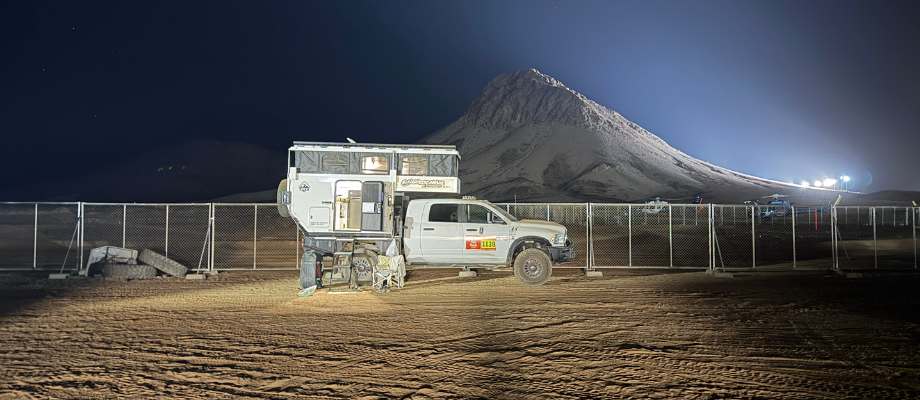
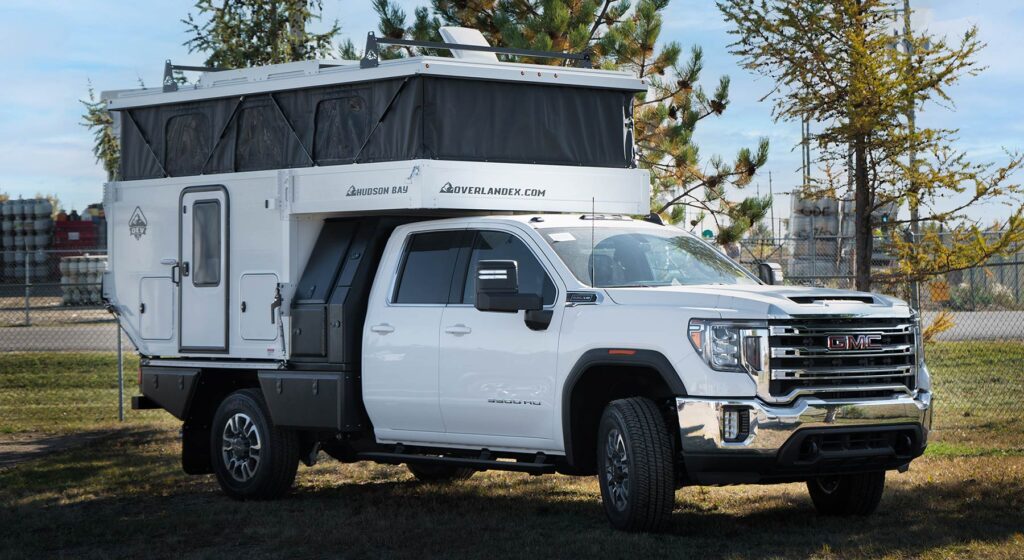
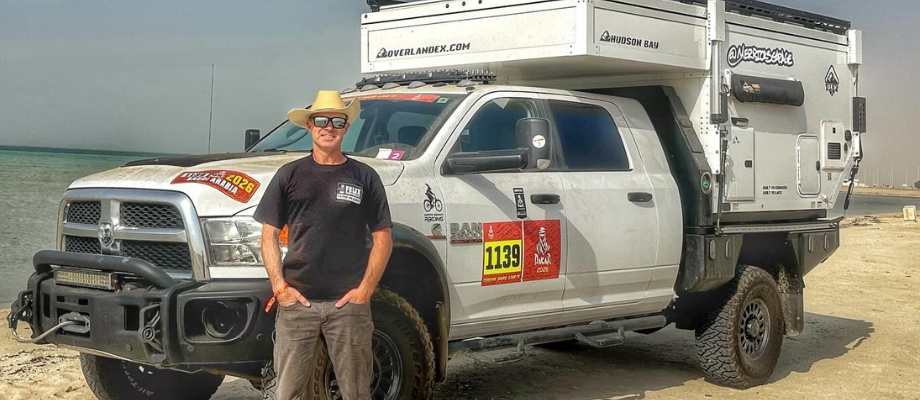
This year, one of our customers put that question to the ultimate test, choosing an OEV Hudson Bay 6.75 mounted on an Aluma Tray flatbed as their chase vehicle and mobile base camp. While other RV-type campers crumbled under the relentless punishment of Dakar’s roads, their OEV didn’t just survive—it thrived.
The Challenge: Racing Dakar (From the Support Side)
Our customer is no stranger to Dakar. Having raced the rally five times previously, with his most recent appearance in 2019, he returned this year to compete in the Dakar Classic—a vintage race that shadows the main event. But racing Dakar means more than just piloting a car through the desert. It means managing an entire mobile operation: spare parts, mechanics, tools, and crucially, a place to rest and prepare for the next day’s stage.
“The rally organizers do provide showers and toilets which aren’t too bad, but sleeping arrangements are up to each competitor,” he explains. “Choices range from ground tents to luxury motorhomes. There are 5,000 people moving along each night with the rally, so the logistics around all this are immense.”
For this mission, he chose the Hudson Bay 6.75 camper on the Aluma Tray flatbed—a setup built for serious overland travel, now facing the most demanding road conditions on earth.
The Proving Ground
The roads of the Dakar Rally are unlike anything most vehicles will ever encounter. Hundreds of kilometers of corrugated gravel roads shake equipment apart. Temperature swings from 4°C to 25°C at night test seals, batteries, and climate systems. The constant movement, quick setup and breakdown requirements, and the need to cruise at speed to reach the next bivouac add layers of complexity that expose any weakness in design or construction.
This is where the gap between “RV-quality” and “expedition-quality” becomes brutally clear. Traditional RV construction—with wood framing, screwed-together cabinetry, and components designed for weekend camping—simply doesn’t hold up. Our customer witnessed it firsthand: other RV-type campers in the rally falling apart under the abuse, their crews dealing with broken cabinets, failed seals, and structural issues while trying to support their race teams.
Built Different: The OEV Performance
Over twelve days of racing and support operations, the Hudson Bay proved why an aluminum exoskeleton, composite walls, and aluminum furniture matter.
“It has been incredible to have the OEV Hudson Bay as our base camp for the rally,” our customer reports. “It is so comfortable—I sleep on the upper bed and my codriver sleeps on the lower bed. Temperatures have ranged from 4 to 25°C at night and the OEV handles it all.”
But comfort was just the beginning. The real test was functionality under pressure:
Living and Working Space: “We have room to relax, check the next day’s roadbooks, read, wash up and get organized—rally racing requires a huge amount of gear and the OEV has plenty of room for everything.”
Electrical Systems: The Hudson Bay’s dual charging system proved invaluable during the constant movement between bivouacs. Every time the Ram fired up for the drive to the next stage, the DC-to-DC charging system efficiently charged the camper’s batteries, ensuring they were always topped up and ready. Meanwhile, the solar panels on the roof captured the abundant Saudi Arabian sun during stationary periods, providing an additional charging source that kept the system running at peak capacity. “Because we’re on the move each day, the Ram’s engine has been keeping batteries topped up no problem and we’ve been using the fans, fridge, lights, water pump every day.” No generator needed. No worrying about power management. The integrated charging system—both from the vehicle and the sun—handled it seamlessly, allowing the team to focus on supporting the race car rather than managing their camp’s electrical needs.
Structural Integrity: This is where the OEV truly separated itself. “The roads here in Saudi range from smooth blacktop to 100s of kms of corrugated gravel roads. The OEV has had zero issues—build quality is excellent and it gives us confidence to cruise at the speeds we need to in order to make it to the next base camp to meet the race car.” Zero issues. Not “minor repairs needed.” Not “we made it work.” Zero issues across hundreds of kilometers of the worst roads imaginable.
The OEV Difference: Engineering That Shows Up When It Matters
What makes the difference between a camper that survives Dakar and one that doesn’t? It comes down to fundamental design philosophy.
Aluminum Exoskeleton Construction: Unlike wood-framed RVs that absorb moisture, flex, and deteriorate, our aluminum exoskeleton is a load-bearing structural framework that forms the very backbone of the camper. This isn’t decorative—it’s engineered structural integrity that maintains rigidity and durability even under constant vibration and impact. Every joint, every connection is designed to handle the punishment of rough terrain, which is exactly why it survived Dakar without a single structural failure.
Proprietary Composite Walls: Our composite wall construction uses a proprietary blend designed by us specifically for extreme overland conditions. These panels provide superior insulation and structural integrity without the weight and vulnerability of traditional RV construction methods—and critically, they won’t delaminate or come apart under stress. Through extreme temperature swings and relentless road vibration at Dakar, these panels held up flawlessly, proving the value of engineering materials from the ground up rather than relying on off-the-shelf solutions.
Integrated Aluminum Furniture: The Hudson Bay’s aluminum furniture isn’t just about durability—it’s an integral part of the camper’s geometric structural integrity. While traditional RVs treat cabinets and furniture as mere storage additions, our aluminum furniture is engineered to contribute to the overall strength and rigidity of the structure. This integrated approach means that cabinets, benches, and storage systems work together with the exoskeleton to create a unified, reinforced framework. The result at Dakar? Zero cabinet failures, no screws working loose, no particle board delaminating—because the furniture itself is part of what kept the entire structure solid and reliable day after day.
Fully Isolated Mounting System: The Aluma Tray flatbed is fully isolated from the vehicle’s chassis through our proprietary mounting system, and the camper is likewise isolated from the tray. This creates a true three-stage isolation system that prevents wear and tear by absorbing vibration at each level—chassis to tray to camper. The result? No destructive energy transfer that would normally shake components loose and cause premature failure. This full isolation is why the Hudson Bay arrived at each bivouac as solid and intact as when it left the previous one.
Component Quality: From the electrical system keeping up with daily demands to the seals maintaining integrity through temperature swings, every component in an OEV is chosen for reliability, not price point.
Real-World Testing Philosophy: We build our campers for serious overland use because that’s what our customers do. Dakar isn’t an edge case—it’s validation of what we’ve been designing for all along.
The Verdict
Our customer’s conclusion says it all: “I’m thrilled with the camper and highly recommend it to anyone who is looking at doing a multi-week adventure that requires quick setup and takedown and the ability to drive on any kind of road.”
If an OEV Hudson Bay can serve as a reliable base camp for the Dakar Rally—arguably the most demanding automotive event on the planet—it can handle your overlanding adventures. Whether you’re planning a multi-week expedition across South America, a season exploring remote corners of North America, or anything in between, you need equipment that won’t let you down when you’re far from help.
The Dakar Rally isn’t just another line on the Hudson Bay’s resume. It’s proof that when you build things right from the start, they perform when it matters most.
Ready to build your own adventure-proof setup? Explore the Hudson Bay 6.75 and our full lineup of overland campers designed for real-world demands. Configure your OEV today or contact our team to discuss your expedition needs.